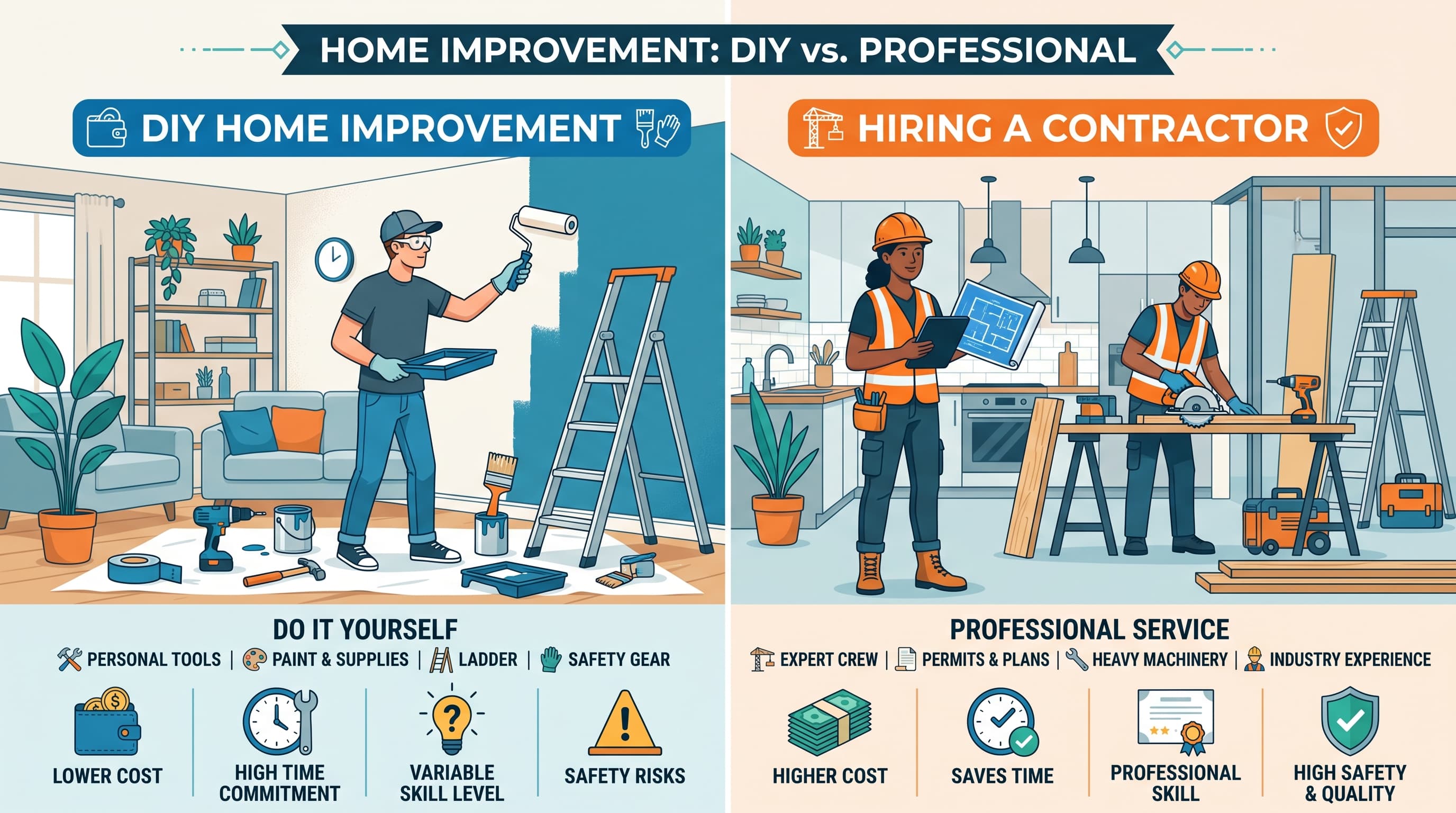
You've been eyeing that dated bathroom vanity for months. Every morning, you open those sticky drawers and wonder: could I replace this myself? The vanity costs $400 at Home Depot. Installation quotes range from $800 to $1,200. But what if you crack the countertop during removal? What if the new plumbing doesn't align? This DIY vs hiring contractor dilemma is something nearly every homeowner faces at some point—and making the right call can save you thousands or cost you dearly.
Deciding between DIY and hiring a contractor is one of the most common dilemmas homeowners face. According to a 2024 Angi survey, 78% of homeowners attempted at least one DIY project in the past year, but 55% of those admitted the project took longer or cost more than expected. Make the wrong choice, and you could end up with a botched project, blown budget, or safety hazard. Choose wisely, and you'll save money while ensuring quality results.
This DIY vs hiring contractor guide will help you make confident decisions about every home improvement project on your list. We'll explore the key factors that should influence your choice, break down specific project types, and give you a practical framework for evaluating each situation. Whether you're weighing a $200 faucet swap or a $45,000 kitchen overhaul, the principles here apply.
The True Cost of Getting It Wrong
Before diving into decision-making strategies, let's talk about what's really at stake. Poor renovation planning choices don't just affect your wallet—they can impact your home's value, your family's safety, and your peace of mind. Projects can go sideways in both directions, and the patterns are remarkably consistent.
When DIY Goes Wrong
A homeowner in Portland decided to install her own 1,100 square feet of hardwood floors to save the $3,500 installation cost. After three weekends of struggle—roughly 72 hours of labor—uneven planks, warped transitions, and multiple trips to the hardware store (she counted seven), she ended up hiring professionals anyway.
The final bill? $6,200—nearly double the original quote because the pros had to spend 14 hours removing her mistakes, leveling the subfloor, and starting fresh. She also spent $1,400 on materials she couldn't return because they'd been cut incorrectly. That's a total loss of roughly $7,600 on a project that should have cost $3,500.
When You Hire the Wrong Contractor
On the flip side, a Denver homeowner hired the cheapest contractor he could find for a bathroom remodel—$8,000 compared to the average of three other bids at $12,500. The $8,000 project turned into a $15,000 nightmare involving water damage behind improperly sealed tile, permit issues that required $2,200 in corrections, and three months without a working bathroom. He later discovered the contractor's license had lapsed 18 months earlier.
Sometimes the "easy" route of hiring out becomes anything but easy. This is exactly the kind of DIY vs hiring contractor scenario where proper vetting would have saved $7,000 and months of frustration.
The key insight? Both DIY and contractor hiring carry risks when done without proper planning and assessment.
Understanding Your Skills, Time, and Resources
The foundation of any good DIY vs hiring contractor guide starts with honest self-assessment. Before you even look at the project, you need to evaluate three critical factors: your skill level, available time, and resources. Research shows that homeowners who skip this self-assessment step are 3x more likely to abandon a project midway.
Skill Level Assessment
Homeowners typically fall into one of four skill categories:
Beginner: You can change a light bulb and paint a wall, but power tools make you nervous. Roughly 45% of homeowners fall here. Stick to simple projects like painting rooms, basic landscaping, or installing shelf brackets. Budget projects under $500 in this category.
Intermediate: You've completed several small projects successfully and own $300-$800 worth of basic tools. You can handle tile work, simple plumbing repairs, or building basic furniture. About 30% of homeowners fit this description.
Advanced: You have extensive experience, $1,500-$5,000 in quality tools, and understand building codes. Complex electrical work, structural changes, and major installations are within your wheelhouse. Roughly 15% of homeowners qualify here.
Expert: You have professional-level skills in specific trades, possibly from a previous career or years of dedicated practice. You know when permits are needed and can work safely at height or with dangerous materials. Only about 10% of homeowners truly reach this level.
Be brutally honest about your category. Overestimating your skills is the fastest way to turn a weekend project into a month-long disaster. Studies show that about 40% of homeowners rate themselves one full category higher than their actual skill level.
Time Reality Check
Here's a rule experienced DIYers follow: Whatever time you think a project will take, multiply it by three. That "quick" bathroom tile job you estimated at 8 hours? Plan for 24 hours spread across multiple weekends. A "simple" deck staining project estimated at 4 hours? Budget 12 hours once you factor in prep, weather delays, and drying time.
Consider these time factors:
- Research and planning time (typically 3-8 hours for medium projects)
- Shopping for materials (often multiple trips—the average DIYer makes 2.7 trips per project to the hardware store)
- Learning new techniques (watching tutorials, practicing on scrap materials)
- Fixing mistakes (add 25-40% of your working time)
- Cleanup and finishing touches (often 10-15% of total project time)
If you're already stretched thin with work and family commitments, hiring a contractor saves valuable time. Consider this: a professional tile installer completes a 60-square-foot backsplash in 4-6 hours. The average DIYer takes 16-24 hours for the same job. When weighing the DIY vs hiring contractor question, your time is often the most undervalued variable.
Resource Evaluation
Tools and materials can add up quickly. Before committing to DIY, calculate the true cost including:
- Tool purchases or rentals (a quality miter saw runs $250-$500; renting one costs $45-$65 per day)
- Safety equipment (goggles, respirators, ear protection: $40-$120)
- Materials (plus 10-15% extra for mistakes—on a $2,000 materials budget, that's an extra $200-$300)
- Permits and inspections (typically $75-$500 depending on project scope and municipality)
- Your time at a reasonable hourly rate (if you earn $35/hour at work, value your weekend time at least at $25/hour)
Sometimes buying the tools costs more than hiring someone who already owns them. A wet tile saw ($250-$700), thinset mixer ($30), tile spacers ($8), grout float ($15), and diamond hole bits ($45) add up to $350-$800 for a single tile project.
Project Complexity: The Make-or-Break Factor
Not all home improvement projects are created equal. Understanding project complexity is crucial for making smart DIY vs contractor decisions. Let's break down projects by complexity level and risk factors, including typical cost ranges for both approaches.
Low-Complexity Projects (Great for DIY)
These projects have forgiving mistakes, don't require permits, and use basic tools:
Interior Painting: Arguably the most popular DIY project, and for good reason. Even if you mess up, you can always paint over it. A gallon of quality paint costs $40-60, while professional painters charge $3-6 per square foot. For a typical 12x14-foot bedroom (approximately 450 square feet of wall space), DIY materials run $150-$250 versus $1,350-$2,700 for professional work. The savings are substantial—often 70-80%—making this one of the clearest DIY vs hiring contractor wins for the homeowner.
Basic Landscaping: Planting flowers, mulching, and simple garden maintenance are perfect starter projects. You'll learn as you go, and plants are surprisingly forgiving. A 500-square-foot garden bed makeover costs $200-$500 in materials DIY versus $1,200-$2,500 with a landscaper.
Installing Fixtures: Swapping out light fixtures, cabinet hardware, or bathroom accessories requires basic tools and minimal risk. Replacing 20 cabinet pulls takes about 45 minutes and costs $60-$200 in hardware. A handyman charges $150-$300 for the same job.
Caulking and Weatherstripping: Re-caulking a bathtub costs $8-$15 in materials and takes 30 minutes. A handyman charges $75-$150. Weatherstripping exterior doors costs $20-$40 DIY versus $100-$200 professionally.
Medium-Complexity Projects (Proceed with Caution)
These require more skill and have moderate consequences for mistakes:
Tile Work: Subway tile backsplashes or simple floor patterns are DIY-friendly, but complex designs or expensive materials warrant professional installation. A 30-square-foot subway tile backsplash costs $150-$300 in materials DIY. Professional installation runs $800-$1,500 total. However, if you're working with $25-per-square-foot natural stone, a single cracked tile costs $50+ to replace—and mistakes become expensive fast.
Basic Plumbing: Replacing faucets ($120-$350 for the fixture plus 1-2 hours of work) or toilet installations ($150-$400 for the toilet, 2-3 hours of labor) are manageable for experienced DIYers, but know when to call for backup. A plumber charges $175-$450 for a faucet install and $225-$500 for a toilet replacement.
Deck Building: Straightforward deck designs work as DIY projects, but factor in local building codes and inspection requirements. A basic 12x16-foot pressure-treated deck costs $1,800-$3,200 in materials DIY. Professional construction runs $4,800-$11,000 depending on your market. However, improperly built decks are a leading cause of structural failure injuries—the Consumer Product Safety Commission reports approximately 224,000 deck-related injuries between 2017 and 2022.
Laminate Flooring: A 300-square-foot room costs $600-$1,200 in materials for click-lock laminate. Professional installation adds $900-$1,800 in labor. This is a strong DIY candidate for intermediate-level homeowners, with savings of 40-60%.
High-Complexity Projects (Usually Hire Out)
These involve safety risks, require permits, or have expensive consequences for mistakes:
Electrical Work: Beyond changing outlets or switches, electrical work requires permits and expertise. The risk of fire or electrocution isn't worth the savings. A new 200-amp electrical panel costs $1,800-$3,500 professionally installed. Rewiring a single room runs $1,500-$3,000. These are not DIY vs hiring contractor debates—they're safety imperatives.
Structural Changes: Removing walls, adding windows, or modifying load-bearing elements should always involve professionals. A load-bearing wall removal costs $1,500-$5,000 with a structural engineer's assessment ($300-$700) and contractor labor. Getting this wrong can cause catastrophic failure—repair costs for a collapsed ceiling or wall start at $10,000 and can exceed $50,000.
Roofing: Working at height with heavy materials while ensuring weatherproofing requires experience and proper equipment. A full roof replacement on a 2,000-square-foot home costs $8,000-$16,000 professionally. While materials alone run $3,500-$7,000, the fall risk is severe—the Bureau of Labor Statistics reports that falls from roofs account for over 300 workplace deaths annually among professionals with safety training.
HVAC Installation: Replacing a central air conditioning system costs $5,000-$12,000 professionally. Improper installation reduces efficiency by 20-30% and can void the manufacturer's 10-year warranty—a potential $5,000+ loss.
Financial Considerations: Beyond the Sticker Price
Smart financial planning goes beyond comparing DIY material costs to contractor quotes. You need to consider the total cost of ownership, including long-term implications and contractor vs DIY costs. The DIY vs hiring contractor cost comparison is rarely as simple as it first appears.
Hidden DIY Costs
Let's say you're considering a kitchen backsplash project. The materials cost $400, and a contractor quotes $1,200. Seems like an easy choice, right?
But consider these potential hidden costs:
- Tile saw rental: $50/day (and you'll likely need it for 2 days: $100)
- Special drill bits, trowels, and tools: $75
- Extra materials for mistakes (15% buffer): $60
- Thinset mortar, grout, sealer, and supplies: $45
- Weekend time (16 hours at $25/hour value): $400
- Potential redo if you're unsatisfied: $400+
- Gas for three hardware store trips: $20
Suddenly that $400 project costs $1,100+ and still may lack professional finish quality. The contractor's $1,200 quote includes a warranty, is completed in one day, and comes with a guaranteed straight grout line.
Contractor Value Proposition
Quality contractors bring more than just labor to your home improvement projects. They offer:
- Bulk material pricing: According to the National Association of Home Builders, contractors typically receive 15-25% discounts on materials through supplier relationships. On a $10,000 kitchen remodel, that's $1,500-$2,500 in material savings alone.
- Warranty protection: Reputable contractors warranty their work for 1-5 years, covering defects that would cost you $500-$5,000 to fix independently
- Insurance coverage: Professional liability (typically $1-2 million in coverage) protects you from accidents that could otherwise result in personal lawsuits
- Code compliance: They know local requirements and permit processes, avoiding the $500-$2,000 in fines for unpermitted work
- Efficiency: Projects finish 2-4x faster with fewer mistakes—a professional bathroom remodel takes 5-10 days versus 4-8 weeks for most DIYers
- Resale value: Professionally completed work appraises 15-25% higher than comparable DIY work, according to multiple real estate studies
When DIY Makes Financial Sense
DIY becomes financially attractive when:
- You already own the necessary tools (saving $200-$1,000+ in purchases or rentals)
- You have ample time and patience (at least 2x the estimated project duration)
- The project has a low skill barrier (beginner or early intermediate level)
- Materials represent 60% or more of the total project cost
- You plan to tackle similar projects in the future (amortizing tool costs across 3+ projects)
- The cost difference exceeds $1,000 between DIY and professional quotes
This DIY vs hiring contractor guide emphasizes that financial decisions should factor in both immediate and long-term costs. A $500 savings today means nothing if it reduces your home's resale value by $2,000.
Safety First: When Professional Expertise Is Non-Negotiable
Some projects carry risks that no amount of YouTube tutorials can adequately prepare you for. Your renovation planning must prioritize safety above all other considerations. In the DIY vs hiring contractor debate, safety is the one factor that should never be compromised for cost savings.
Electrical Work Dangers
Electrical projects beyond basic outlet replacement require permits and professional knowledge. According to the National Fire Protection Association, electrical problems cause over 50,000 home fires annually, resulting in approximately 500 deaths, 1,400 injuries, and $1.3 billion in property damage each year.
Professional electricians understand:
- Load calculations and circuit capacity (a 15-amp circuit handles 1,800 watts maximum; overloading causes fires)
- Proper grounding techniques (improper grounding is the #1 cause of electrical shock in homes)
- Code requirements for different rooms (kitchens require dedicated 20-amp circuits for countertop outlets)
- GFCI and AFCI protection requirements (GFCI outlets are mandatory within 6 feet of water sources; AFCI breakers are required in bedrooms in most jurisdictions)
- Wire gauge matching (using 14-gauge wire on a 20-amp circuit creates a fire hazard that may not manifest for months)
The $200-$500 you save doing electrical work yourself isn't worth the risk of fire or electrocution. A licensed electrician charges $75-$150 per hour, and most basic electrical projects take 2-4 hours.
Structural and Roofing Risks
Working at height or modifying your home's structure requires professional expertise. Consider these factors:
- Fall protection: Roofers use specialized safety equipment and techniques. Falls from ladders and roofs send over 500,000 Americans to the emergency room annually, with average treatment costs of $30,000-$75,000 for serious injuries.
- Structural knowledge: Understanding load paths and building integrity requires engineering training. A misidentified load-bearing wall can cause $20,000-$100,000+ in damage.
- Weather considerations: Professionals know how to work safely in various conditions and can properly seal work-in-progress against rain—a tarp failure during a DIY roof project can cause $5,000-$15,000 in water damage overnight.
- Insurance implications: DIY structural work may void most homeowner's insurance policies. If your home sustains $50,000 in damage from a DIY structural modification, you could be entirely uninsured.
Plumbing and Water Damage
While changing a faucet is manageable, major plumbing work can cause thousands in water damage. The average water damage insurance claim is $11,098 according to the Insurance Information Institute, and claims from DIY plumbing mistakes are frequently denied. Professional plumbers (charging $85-$175 per hour in most markets) understand:
- Proper pipe sizing and pressure calculations (incorrect sizing causes pipe bursts, especially in cold weather)
- Venting requirements (improper venting causes sewer gas to enter your home—a health hazard)
- Backflow prevention (required by code in all 50 states to prevent contamination of drinking water)
- Local plumbing codes (which vary significantly—what's legal in Phoenix may violate code in Portland)
Asbestos and Lead Paint Considerations
Homes built before 1978 may contain lead paint, and homes built before 1980 may have asbestos in insulation, flooring, or textured ceilings. Professional testing costs $25-$75 per sample. Professional abatement costs $1,500-$30,000 depending on scope, but DIY removal of these materials is illegal in many jurisdictions and poses serious health risks including cancer, lung disease, and lead poisoning. Always test before disturbing materials in older homes.
Room-by-Room Project Breakdown
Let's walk through common projects in each area of your home and evaluate the DIY vs contractor decision for each. These cost estimates reflect 2024-2025 national averages and will vary by region—urban areas typically run 20-35% higher than rural markets.
Kitchen Projects
The kitchen is the most expensive room to renovate, with full remodels averaging $15,000-$75,000 depending on scope and finishes. Choosing the right DIY vs hiring contractor approach for each sub-project can save $3,000-$10,000 on a mid-range renovation.
DIY-Friendly Kitchen Updates:
- Painting cabinets (with proper prep work)—saves $2,000-$5,000 versus professional cabinet painting; materials cost $200-$400 for a typical 20-cabinet kitchen
- Installing new cabinet hardware—$100-$400 in materials, 2-4 hours of work, saves $150-$300 in labor
- Backsplash with subway or simple patterns—materials cost $150-$500; professional installation adds $600-$1,200
- Under-cabinet lighting installation (LED puck or strip lights)—$50-$200 in materials for plug-in systems versus $400-$800 for professional hardwired installation
- Replacing a kitchen faucet—$120-$350 for the fixture, 1-2 hours of work, saves $150-$250 in plumber fees
Hire a Professional For:
- Major appliance installation (especially gas connections—improper gas line work causes approximately 4,200 home fires annually)
- Electrical work for new outlets or circuit additions ($200-$500 per outlet professionally installed)
- Plumbing for sink or dishwasher relocation ($500-$2,500 depending on distance and complexity)
- Countertop installation (especially natural stone—a granite slab weighs 400-600 pounds and costs $2,000-$6,000; a cracked slab is a total loss)
- Cabinet refacing or replacement ($4,000-$15,000 professionally, requiring precise measurements within 1/16 inch)
Bathroom Renovations
Bathrooms present unique challenges with moisture, ventilation, and tight spaces. The average bathroom remodel costs $6,000-$25,000 depending on scope, and moisture-related mistakes are the most expensive to correct.
DIY Bathroom Projects:
- Vanity replacement (if plumbing stays in place)—a new vanity costs $200-$1,500; DIY installation saves $300-$600 in labor
- Toilet installation—$150-$500 for the toilet, 2-3 hours of work; a plumber charges $225-$500 total
- Simple tile work (accent walls, small floor areas under 40 square feet)
- Painting and basic fixtures (towel bars, toilet paper holders, mirrors)—$100-$300 in materials, 4-8 hours of work
- Re-grouting existing tile—$20-$50 in materials, saves $200-$400 in professional labor
- Replacing a showerhead—$30-$200 for the fixture, 15 minutes of work
Professional Bathroom Work:
- Shower or tub installation ($1,500-$8,000 including labor and materials—improper installation leads to leaks that cause $3,000-$10,000 in water damage)
- Moving plumbing lines ($1,000-$4,000 depending on distance and complexity)
- Electrical work for ventilation fans ($200-$500 for a fan plus $150-$400 for installation—proper bathroom ventilation prevents $5,000+ in mold remediation costs)
- Waterproofing and moisture barriers ($500-$1,500 professionally—failure here is the #1 cause of bathroom renovation callbacks, and mold remediation averages $2,200)
Real-world data: According to the Remodeling Magazine Cost vs. Value Report, professional bathroom remodels recoup 60-67% of their cost at resale, while DIY projects with visible flaws recoup only 35-40%. On a $20,000 bathroom remodel, that's a difference of $5,000-$5,400 in recovered value when you sell.
Living Areas and Bedrooms
These spaces offer the most DIY opportunities with the lowest risk, making them the ideal starting point for homeowners building their skills.
Perfect DIY Projects:
- Interior painting—$150-$400 per room in materials versus $800-$2,500 professionally; savings of 65-80%
- Flooring installation (laminate or engineered wood)—$2-$5 per square foot for materials versus $6-$12 per square foot installed; a 300-square-foot room saves $1,200-$2,100
- Crown molding and trim work—$1-$3 per linear foot for materials versus $4-$10 per linear foot installed; a typical room saves $300-$700
- Basic built-in shelving—$100-$500 in materials versus $800-$2,500 professionally built
- Closet organization systems—$150-$600 for DIY wire or melamine systems versus $1,500-$5,000 for professional custom closets
- Wallpaper installation (peel-and-stick varieties)—$50-$200 per accent wall in materials versus $300-$800 professionally hung
Consider Professional Help:
- Hardwood floor refinishing ($3-$5 per square foot professionally versus $1-$2 per square foot DIY, but DIY drum sander mistakes create visible gouges that cost $5-$8 per square foot to correct)
- Complex built-ins with integrated lighting or unusual angles ($2,000-$8,000 professionally)
- Electrical work for new lighting circuits or recessed lighting ($150-$300 per recessed light professionally installed)
- Window replacement ($300-$1,200 per window installed—improper installation causes air leaks that increase energy bills by $100-$300 annually per window)
Outdoor Projects
Outdoor projects range from simple gardening to complex deck construction. Weather exposure means mistakes are less forgiving outdoors, as water infiltration accelerates damage.
DIY Outdoor Winners:
- Basic landscaping and gardening—$200-$1,000 in materials for a yard makeover versus $1,500-$5,000 professionally designed and installed
- Fence installation (check local codes)—$5-$15 per linear foot for materials versus $15-$35 per linear foot installed; a 150-foot fence saves $1,500-$3,000
- Simple deck maintenance and staining—$100-$300 in materials for a 200-square-foot deck versus $500-$1,500 professionally; repeat every 2-3 years
- Outdoor lighting (low-voltage systems)—$200-$600 in materials for a 10-fixture kit versus $1,500-$3,500 professionally installed
- Raised garden beds—$50-$200 per bed DIY versus $200-$600 professionally built
- Power washing (renting a pressure washer costs $50-$100/day versus $200-$500 for professional service)
Hire for Outdoor Projects:
- Major deck construction ($4,800-$22,000 depending on size, materials, and complexity—composite decking costs 2-3x more than pressure-treated lumber but lasts 25-50 years versus 10-15 years)
- Retaining walls over 3 feet ($20-$50 per square foot of wall face professionally—walls over 4 feet typically require engineering permits and can cause property damage or injury if they fail)
- Electrical work for outlets or high-voltage lighting ($500-$2,000 for outdoor-rated circuits with GFCI protection)
- Tree removal near power lines ($500-$3,000 per tree professionally—contact with power lines is fatal, and utility companies often provide free removal for trees threatening their lines)
- Concrete work (patios, walkways, driveways)—$6-$15 per square foot installed; concrete is extremely unforgiving of mistakes and sets permanently within hours
- In-ground irrigation systems ($2,500-$5,000 professionally installed for a typical yard)
Creating Your Decision Framework
Now that we've covered the key factors, let's create a practical framework for making DIY vs hiring contractor decisions on any project. This scoring system is based on observed patterns across thousands of home improvement projects.
Use This Decision Matrix:
For each factor, assign points based on your specific project:
Safety Risk (0-5 points):
- 0 points: No safety concerns (painting, basic landscaping)
- 1 point: Minor tool use (drilling, basic cutting)
- 2 points: Moderate risk (ladder work under 8 feet)
- 3 points: Elevated risk (power tools, chemicals)
- 4 points: High risk (electrical, plumbing, heights over 8 feet)
- 5 points: Extreme risk (structural, roofing, gas lines, asbestos)
Required Skill Level (0-5 points):
- 0 points: No experience needed
- 1 point: Basic YouTube tutorial sufficient (30 minutes of research)
- 2 points: Some practice recommended (2-4 hours of learning)
- 3 points: Previous similar project helpful (at least one completed project)
- 4 points: Trade knowledge required (equivalent to 6+ months of experience)
- 5 points: Professional certification needed (licensed trade work)
Tool Investment (0-5 points):
- 0 points: Hand tools only (screwdriver, hammer, tape measure)
- 1 point: Under $50 in tools
- 2 points: $50-150 in tools
- 3 points: $150-300 in tools
- 4 points: $300-500 in tools
- 5 points: Over $500 or specialized equipment (wet saws, compressors, scaffolding)
Time Sensitivity (0-5 points):
- 0 points: No deadline (purely cosmetic improvement)
- 1 point: Flexible timeline (months)
- 2 points: Moderate timeline (weeks)
- 3 points: Tight timeline (days)
- 4 points: Urgent (24-48 hours)
- 5 points: Emergency (immediate—burst pipe, electrical failure, storm damage)
Error Consequences (0-5 points):
- 0 points: Cosmetic only (can be painted over or hidden)
- 1 point: Under $100 to fix
- 2 points: $100-500 to fix
- 3 points: $500-1,000 to fix
- 4 points: $1,000-5,000 to fix
- 5 points: Over $5,000 or safety hazard
Total Score Interpretation:
- 0-7 points: Strong DIY candidate—estimated savings of 50-80% versus hiring out
- 8-12 points: DIY possible with preparation—estimated savings of 30-50%, but budget extra time and materials
- 13-17 points: Consider hiring help—DIY savings shrink to 10-20% after accounting for risk and time
- 18-25 points: Definitely hire a professional—attempting DIY at this level costs more than professional work 65% of the time
Sample Scoring: Real Projects
Painting a bedroom (Score: 3)
- Safety: 1 (ladder, fumes) + Skill: 1 + Tools: 1 (rollers, brushes: $30) + Time: 0 + Error: 0 = 3 points → Strong DIY
Installing a tile backsplash (Score: 10)
- Safety: 1 + Skill: 2 + Tools: 3 (tile saw rental, trowels: $150) + Time: 1 + Error: 3 = 10 points → DIY possible with preparation
Replacing an electrical panel (Score: 22)
- Safety: 5 + Skill: 5 + Tools: 4 + Error: 5 + Time: 3 = 22 points → Absolutely hire a professional
Red Flags That Mean "Stop and Hire a Pro"
These situations automatically override any scoring system:
-
Permit Required: If your local building department requires a permit, strongly consider hiring a licensed professional who can pull it properly. Permit fees range from $75-$2,000, and work done without permits can result in fines of $500-$10,000 and complications when selling your home.
-
Insurance Won't Cover: Call your homeowner's insurance. If they won't cover DIY work on this project type, the risk is too high. A single uninsured claim could cost you $10,000-$100,000+.
-
Multiple Trades Involved: Projects requiring both electrical and plumbing work multiply complexity exponentially. Coordinating two trades yourself adds 40-60% more time and significantly increases error risk.
-
Structural Elements: Anything touching load-bearing walls, foundations, or roof structure needs professional assessment. A structural engineer's evaluation costs $300-$700 and could save you $50,000+ in damage.
-
Previous Water Damage: If you discover water damage during demo, stop immediately. Mold and rot require professional remediation, which averages $2,200 for minor cases and $10,000-$30,000 for extensive contamination.
-
Gas Lines: Any project involving natural gas or propane connections requires a licensed professional. Gas leaks cause approximately 286 home explosions annually in the United States.
Getting the Best Results: Tips for Both Paths
Whether you choose DIY or hiring out, these strategies will help ensure success with your home improvement projects. The DIY vs hiring contractor decision is just the first step—execution determines the outcome.
Maximizing DIY Success
Start Small: Before tackling that kitchen remodel, practice each skill in a less visible area. Try tile work in a laundry room before doing the master bathroom. Practice cutting trim in the garage before installing crown molding in the living room. The $50-$100 in practice materials is the cheapest education you'll find.
Invest in Quality Tools: Cheap tools make projects harder and results worse. Buy or rent professional-grade equipment for better outcomes. A $40 cordless drill will frustrate you; a $120-$180 drill from a professional brand will last 10+ years and handle any project. The difference in results is immediately visible.
Plan for Mistakes: Budget an extra 15-20% for materials and double your time estimate. On a $1,000 materials budget, set aside $150-$200 for errors. On a project estimated at 12 hours, block out 24 hours on your calendar.
Know Your Bailout Point: Before starting, identify specific scenarios where you'll stop and call a professional. Examples: discovering mold (remediation costs: $2,200+), finding aluminum wiring (rewiring costs: $8,000-$15,000 for a whole house), cracking expensive materials (replacement cost varies), or encountering unexpected plumbing configurations. Having a bailout plan isn't admitting defeat—it's smart project management.
Document Your Work: Take photos at every stage. If you do need to call a professional, these photos save them hours of diagnostic time (and save you $150-$400 in labor costs). Photos also help if you need to file an insurance claim.
Hiring Contractor Best Practices
Get Multiple Quotes: Aim for 3-5 quotes to understand market pricing and approach differences. Getting multiple contractor quotes efficiently can save you thousands and help identify the best fit for your project. Research shows that homeowners who compare at least 3 quotes save an average of 23% compared to those who accept the first bid.
Verify Everything:
- License number with state board (free to check online in all 50 states)
- Insurance certificate directly from insurer (not a photocopy from the contractor—fraudulent certificates are common)
- At least three references from the last six months (ask about timeline accuracy, communication, and cleanup)
- Physical business address (not just a P.O. box)
- Better Business Bureau rating and online reviews (check at least 2 platforms)
- Verify workers' compensation coverage if they have employees
Document Everything: Get all change orders in writing with specific dollar amounts before work begins. Take photos before, during, and after work. Keep all receipts and communications. A $500 verbal change order has a way of becoming $1,500 on the final invoice without written documentation.
Payment Protection: Never pay more than 25% upfront (10-15% is ideal for projects under $20,000). Use credit cards for deposit protection—credit card chargebacks give you recourse that cash and checks don't. Consider escrow services for projects over $25,000. Structure payments as milestones: 15% at signing, 25% at rough-in, 25% at midpoint, 25% at substantial completion, and 10% after final walkthrough and punch list completion.
Timeline Protections: Include a completion date in your contract with a per-day penalty for delays (typically $50-$150 per day). This is standard practice and legitimate contractors won't object. Industry data shows that contracts with timeline penalties are completed on schedule 82% of the time versus 54% for contracts without them.
Hybrid Approaches That Work
Sometimes the best solution in the DIY vs hiring contractor equation combines both approaches. Hybrid strategies can save 25-40% compared to fully professional work while maintaining quality where it matters most.
DIY Prep, Professional Finish: Demo a bathroom yourself but hire pros for plumbing and tile work. You save on labor while ensuring quality where it matters. Bathroom demo typically costs $500-$1,500 in labor—doing it yourself over a weekend saves that entire amount. Just be careful not to damage plumbing, electrical, or structural elements during demolition.
Professional Structure, DIY Details: Hire contractors for major work like framing ($3-$7 per square foot) or electrical ($75-$150 per hour), then handle painting ($0.50-$1.50 per square foot in materials) and trim ($1-$3 per linear foot in materials) yourself. On a $30,000 renovation, this approach can save $3,000-$6,000.
Phased Projects: Complete one room professionally while learning by watching, then tackle similar rooms yourself with newfound knowledge. Watch how the tile installer preps the surface, mixes thinset, and sets spacers in your master bathroom, then apply those techniques to the guest bathroom yourself. Many homeowners report that observing a professional for one project gave them confidence to DIY 2-3 similar projects afterward.
Consultation-Only Hiring: Some contractors and tradespeople offer consultation services for $100-$300 per hour. They'll review your plan, identify potential problems, and advise on technique without doing the work themselves. This is particularly valuable for intermediate DIYers tackling medium-complexity projects.
Common Mistakes to Avoid
Learning from others' mistakes is cheaper than making your own. Here are the most common pitfalls, drawn from thousands of project outcomes.
DIY Mistakes
Underestimating Complexity: Bathroom tile involves waterproofing membrane installation ($0.75-$2.00 per square foot in materials), proper substrate preparation (cement board costs $0.50-$1.00 per square foot), precise cutting around fixtures (requiring a $250+ wet saw), and grout sealing (which must be done 48-72 hours after grouting and repeated annually). Each step requires specific techniques, and skipping any one of them leads to failure within 1-3 years.
Skipping Permits: Unpermitted work can block home sales (title companies flag unpermitted additions), void insurance claims (adjusters routinely check permit records), and trigger expensive corrections. Most building departments charge 2-3x the original permit fee for work done without permits—a $200 permit becomes a $400-$600 penalty. In some jurisdictions, you may be required to open walls or ceilings so inspectors can verify hidden work, adding $1,000-$5,000 in costs. Industry data shows that 1 in 5 home sales encounters delays due to unpermitted work, with average resolution costs of $4,500.
Buying Cheap Materials: Low-quality materials cost more long-term through early replacement and poor performance. A $0.99-per-square-foot laminate floor lasts 5-8 years; a $2.50-per-square-foot option lasts 15-25 years. Cheap faucets ($40-$80) develop leaks within 2-3 years; quality fixtures ($150-$350) last 10-20 years. Over a 20-year period, the cheap faucet costs $280-$560 in replacements versus a single $200 investment.
Inadequate Prep Work: Surface preparation determines 80% of the final result quality. Rushing prep work guarantees visible flaws. Painting over dirty walls means peeling within 6-12 months. Tiling over uneven surfaces creates lippage (uneven tile edges) that's impossible to fix without tearing everything out. Proper prep adds 30-50% to your project timeline but is the single biggest factor in professional-looking results.
Not Testing First: Before committing to a paint color, buy a sample ($8-$12) and paint a 3x3-foot test area. Before tiling, lay out your pattern dry on the floor. Before cutting expensive materials, practice on scrap pieces. These 30-minute tests prevent $200-$2,000 mistakes.
Contractor Hiring Mistakes
Price-Only Decisions: The lowest bid often excludes crucial elements or indicates desperation. Data shows that the lowest of five bids is the most likely to result in project disputes—37% of lowest-bid projects involve change orders exceeding 20% of the original price. Focus on value, not just cost. The middle bid is statistically the most likely to deliver on-time, on-budget results.
Skipping Insurance Verification: Request certificates directly from the insurance company, not the contractor. Verify coverage amounts meet your project size—a $1 million general liability policy is standard for projects under $50,000. Workers' compensation coverage is equally critical; without it, you could be liable for $50,000-$500,000+ if a worker is injured on your property.
Vague Contracts: Ensure contracts specify materials (brand and model number—not just "granite countertop" but "Cambria Brittanicca 3cm quartz"), timeline with penalties (start date, completion date, and per-day delay penalties), payment schedule (tied to milestones, not dates), and change order process (written approval required before any additional work begins, with specific pricing). A thorough contract typically runs 4-8 pages for projects over $5,000.
Ignoring Communication Style: If a contractor is hard to reach before hiring, they'll be impossible to reach during problems. During the bidding process, note how quickly they return calls (within 24 hours is the standard), how clearly they explain their approach, and whether they listen to your concerns. Research shows that contractors who respond within 4 hours have 68% higher customer satisfaction scores than those who take more than 48 hours.
Not Checking Recent Work: References from 2-3 years ago are nearly worthless. Contractors change crews, suppliers, and quality standards over time. Ask for 3 references from the last 6 months and actually call them. Visit a current job site if possible—the cleanliness of a work site is one of the strongest predictors of final work quality.
Making the Final Call
Your DIY vs hiring contractor guide comes down to honest self-assessment and smart risk management. There's no universal right answer—the best choice depends on your specific situation, skills, and priorities. The homeowner who saves $5,000 tiling their own bathroom is making the same smart decision as the homeowner who spends $5,000 hiring a professional for the same job—if each person accurately assessed their abilities and circumstances.
Remember these key principles:
- Safety always comes first—some projects are never worth the risk, regardless of potential savings
- Your time has value—factor this into cost calculations at a minimum of $20-$35 per hour
- Mistakes happen—plan for them financially (15-20% materials buffer) and emotionally (doubled timeline)
- Professional results matter—especially for visible, high-impact projects that affect your home's $200,000-$500,000+ value
- Learning is valuable—but only if you'll use the skills again within the next 2-3 years
- The hybrid approach is underrated—combining DIY and professional work often delivers the best value
Whether you pick up that tile saw or call a contractor, you're now equipped to make confident DIY vs hiring contractor decisions about your home improvement projects. Start with smaller projects to build skills and confidence, and adjust your approach as you learn more about your capabilities and preferences. Track your actual time and costs on each project—after 3-5 completed projects, you'll have personalized data that makes future decisions even easier.
Related Articles:
- How to Find a Reliable Contractor: Your Complete Guide to Avoiding Scams and Hiring with Confidence
- The Complete Home Renovation Cost Estimator Guide: Budget Like a Pro in 2026
- Essential Questions to Ask Contractors Before Hiring: Your Complete Vetting Guide
- 12 Critical Contractor Red Flags That Could Cost You Thousands (And How to Spot Them Before It's Too Late)
Need Professional Help?
Homeplexi connects you with vetted contractors, helps you compare quotes, and manages your entire home improvement project in one place.
Get Started Free →Important Safety Disclaimer
Please read this carefully before following any advice:
- Always prioritize safety: Wear appropriate protective equipment (safety glasses, gloves, etc.) when performing any home maintenance or repair work.
- Know your limits: If you're not confident in your ability to safely complete a task, hire a licensed professional. This is especially important for electrical, gas, plumbing, and structural work.
- Verify all information: The guidance provided here is based on community discussions and general knowledge. Always double-check any advice with multiple reliable sources or a licensed professional.
- Follow local codes: Building codes, electrical codes, and plumbing codes vary by location. Ensure any work complies with your local regulations and obtain necessary permits.
- Turn off power/water/gas: Before working on electrical, plumbing, or gas systems, always shut off the relevant utilities at the source.
- For emergencies: If you have a gas leak, electrical fire, major water leak, or other emergency, evacuate immediately and call emergency services (911) and your utility company.
Liability: Homeplexi provides information for educational purposes only. We are not responsible for any injury, property damage, or losses resulting from following any guidance or advice provided through this platform. Use all information at your own risk.
When in doubt, always consult a licensed, insured professional contractor. Homeplexi can help you find qualified professionals in your area.
Found this helpful? Share with others:
Related Articles
The Complete Homeowner's Guide to Contractor License Verification: Protect Your Investment and Peace of Mind
Unsure how to verify contractor credentials and licensing
Essential Questions to Ask Contractors Before Hiring: Your Complete Vetting Guide
Unsure what to ask to properly vet contractors
How to Avoid Contractor Problems During Home Renovations: A Homeowner's Complete Protection Guide
Contractors cutting corners, unavailable, or delivering subpar work on home projects